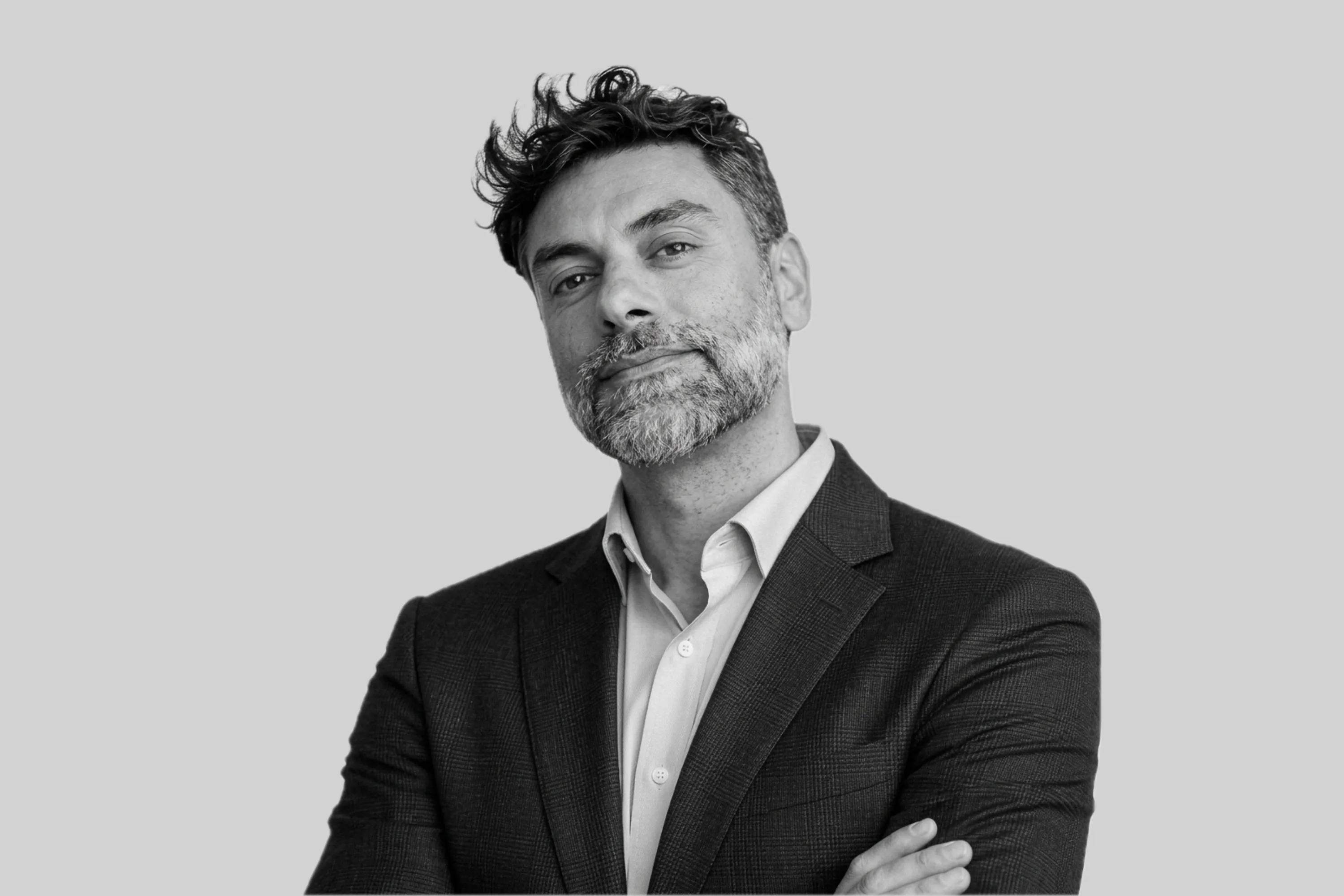
For years I learned to judge the weight of things by eye. Then one day I found out that ideas have weight too, and that you can move them with your fingers.
I · The weight of things
I had numbers in my pockets even at school: a technical institute where they taught balance sheets, law and, luckily for me, computers, back when computers were beige machines that groaned when you switched them on. On those keyboards I learned that every key has its place, and that once the hands know it they no longer need the eyes, so the words came out faster than I could think them.
I began where you begin when the world asks you to be useful straight away: inside a large warehouse, among pallets and boxes. The mornings smelled of damp cardboard and cold iron. The work was ruled by a voice that sometimes seemed to arrive even before the shift began, flat and soulless. Nobody looked it in the face, because it had no face; it was radio-frequency terminals, headsets with a microphone in front of the mouth, that hung in a row like small sleeping animals, and when you put them on your head they were the ones deciding where to go, what to take, when to stop, just like an invisible boss. The pallet jack had a character of its own, too, and I learned it with a great deal of patience and a few sacrifices.
Eleven years is long enough to turn into a kind of wisdom. I learned that a wrongly prepared order in an hour becomes a problem in a day; that the stocktake never lies but insists on being listened to; that every warehouse has someone who knows where everything is, and who usually has no title on the door. I left with a habit I have never lost: insisting that everything has a place, and knowing which one.
II · A smaller island
After a while something came loose. It wasn’t a farewell: it was more like a door left open by mistake, and new air coming in. I found myself drawing homes, rooms for the people who would live in them, furnishing hotels, offices, places where people would spend their hours. For a few months that road took me to an island smaller than my own, where they spoke a language I knew by half and learned to use with skill, by dint of having no choice.
It was there, I think, that I understood something simple and uncomfortable: the warehouse had taught me order, but not how to open those drawers where my imagination was pressing to get out. With the two mixed together, I sensed that somewhere there was a place made to measure for me, and that it was up to me to find the way there.
III · The first lines
In the meantime, while pursuing my favorite hobby, I realized that creating visual content for the web takes the same patience as a warehouse full of cardboard. But patience is often not enough: you need to know specific codes. I wrote a line and watched it run, then I wrote another… I still remember the first time a page on the screen did exactly what I had imagined: a small, silent joy.
There was also another way of looking, one that had nothing to do with code, that of a black box you hold with both hands and of a glass eye to bring up in front of my own. For a while I worked alongside people who made their living at it, on the days when someone promised something forever and everyone else wanted to remember how. There I learned that light is not found, it is waited for; that the small numbers engraved on a ring matter more than they seem; and that between a moment and its memory there is only what you decide to leave outside the frame.
I haven’t been able to stop since. I learned to talk to machines, and machines have a way all their own of answering.
IV · The back of the back
Then the shell arrived, and it came through the service door, head down. A black window on a computer screen with a list of lines, tidy and clean. And it was there that I found out what was behind that mechanical voice in my warehouse days: one line said how many packages to pick, another said in which aisle; another, the exact phrase I was told when I went to the wrong shelf. The curt tone that had made me clench my teeth for years was a numeric value, editable with a text editor and a save. All that time I had answered that voice wondering where it came from. Now I was on the other side, in front of the screen, and the voice was just one line among the others.
A whole year spent next to the Linux servers of companies that run immense warehouses for modern large-scale retail. It’s a curious life: I knew those places from the other side, the back, where the trucks are unloaded and loaded; now I knew them from the back of the back, where a program must never stop so that every truck full of goods can arrive in time to restock a supermarket’s shelves. Linux was already my playground, but I knew it the way a tourist knows a city. There I learned to live in it, to recognize its streets even in the dark, and what had been a game became my workplace. Every day there were systems to configure and phone calls to answer. Something had stopped, somewhere, and it was up to me to get it running again; and there was a satisfaction, every time, in managing it without even seeing the place where it had stopped.
V · Water and the counter
Then, for a few months, I dealt with water. I drew swimming pools in 3D on a screen and then watched them appear for real, pool after pool, with their filters and their linings; I learned that water needs a plan too, and that one wrong line in a drawing becomes a leak in a garden.
And after that, for three years, I lived behind a counter. People came in with a computer that wouldn’t switch on, asking for advice on which printer to choose for their office, invoices and receipts. And then there were the voices coming from far away, those of the Amazon customers. I followed a parcel’s journey from start to finish: the order clicked one evening in a hurry, the shipment that got lost who knows where, the courier who never rang the doorbell, the box that arrived crushed, the return nobody knew how to explain, the complaint written all in capital letters. I learned to listen before answering. I learned that nobody cares how a system works until it stops working, and that at that moment the right word, said at the right time, is worth as much as the refund. Behind that counter everyone got lost in their own way. The customers got lost in their own needs, and only wanted someone who would understand them. The technicians made do with tools ill suited to the job, a few years behind, and the same went for the people who kept the books and for those who made the decisions. Every evening I went home with one more idea of how a program should work, light for those who work and simple for everyone, whatever their familiarity with technology.
VI · Alone
One summer I went back, for a few months, to the place where code had first chosen me. It happens! Things go back to their place when you stop chasing them. And in the end I made a decision that had the sound of one door closing and another opening: to build on my own.
Today I work from home, in Sicily, with a coffee next to the keyboard and a window onto the light. On the other side of the door is my family: my wife and our two children. Every now and then the kitty slips its warm little head under my elbow, and its tail passes in front of the screen, until my hands stop. It gives no orders. It only asks to be looked at. The days have a different rhythm. Now I build platforms, sites, tools: things that serve someone and that someone, I hope, will use without thinking about them. I get help from artificial intelligence, useful and indispensable like a forklift lifting the heaviest pallets: a machine that knows a lot, but the hands that decide where everything goes always remain mine.
Even today, when I can, I go back to waiting for the right moment to capture something that will not come again, any ordinary scene, and when the click comes I find myself with the lightness of someone who looks only for the pleasure of looking.
I don’t know where it will lead. I know I learned to recognize the weight of things, and that ideas, however light, have to be put in their place with the same care with which you close a stocktake, and with which you decide what to leave in and what to leave out of the frame. The rest you can see in my work.